AI-Native Canvas design
This document describes the design artefacts for the AI-Native Canvas part of the overall ODA Canvas design.
There is an introductory video at
Overview
The AI-Native Canvas extends the Open Digital Architecture (ODA) to support AI-native systems at enterprise scale. This work addresses three critical questions:
How do we expose ODA Components as tools for AI agents using MCP (Model Context Protocol)?
How can we deploy AI agents themselves as modular, composable components?
How do we operate a multi-vendor, multi-agent architecture at scale while maintaining governance, security, and responsible AI practices?
Lessons Learned from Catalyst Programs
Three key Catalyst programs from 2025 significantly influenced the AI-Native Canvas approach:
These Catalyst proof-of-concepts revealed several critical patterns:
AI agents as architectural paradigm: Modular, task-oriented, context-aware systems operating autonomously within defined guardrails
MCP as standard: The de facto standard for how agents use APIs as tools, with TM Forum Open APIs well-suited for MCP wrappers
Multi-agent architectures: Modular agents collaborating to deliver use cases, with tightly scoped agents outperforming general-purpose ones
Cross-layer applicability: Agents relevant across every architectural layer and throughout the technology lifecycle
MCP Support in ODA Components
Extending the Component Model
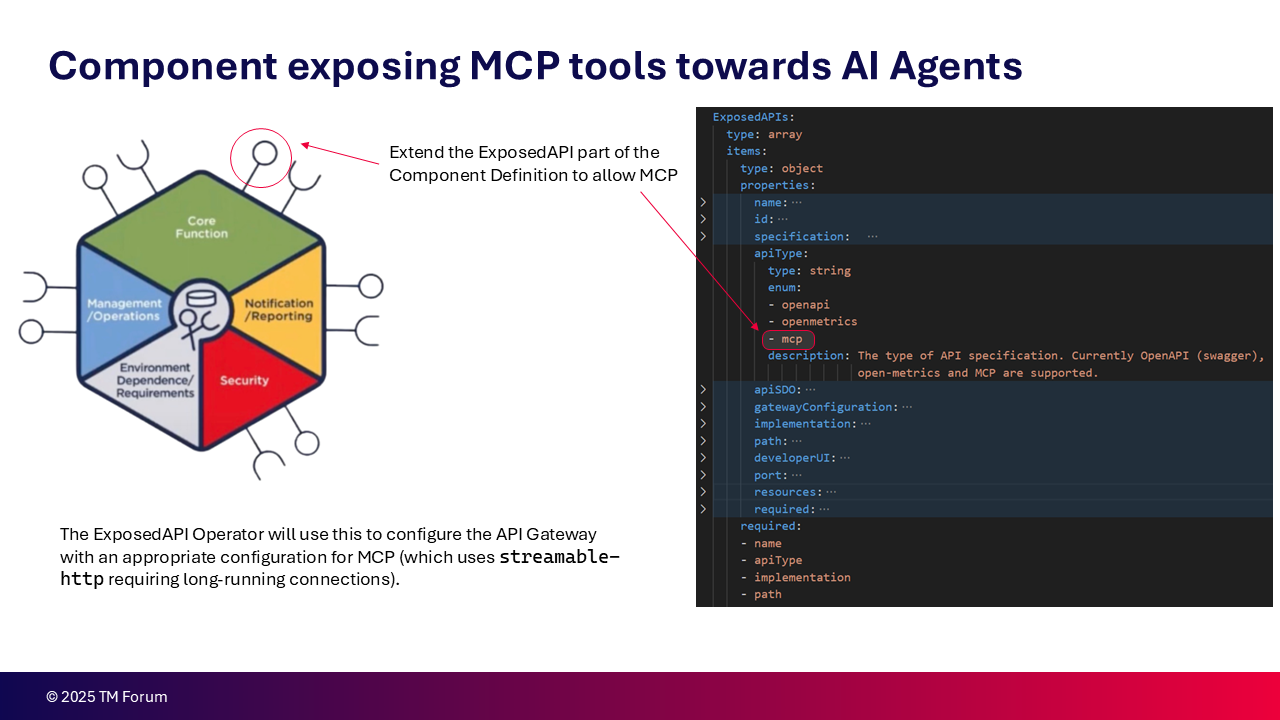
The existing component patterns already include a declarative model for exposing API services. Components expose multiple APIs beyond TM Forum functional APIs, supporting cross-industry standards like OpenMetrics and OpenTelemetry. Extending components to expose MCP APIs was as simple as expanding the enumeration to include MCP.
MCP Requirements
MCP requires special handling because it uses an event-based architecture with long-running HTTP connections rather than standard REST-style integration. This means API Gateways need special configuration to support these persistent connections.
The Canvas has been extended to:
Allow declarative specification of MCP interface types in the component model
Build MCP operators to automatically configure API Gateways for long-running connections
Implement MCP servers for ODA Components (e.g., Product Catalog Management)
MCP Implementation Details
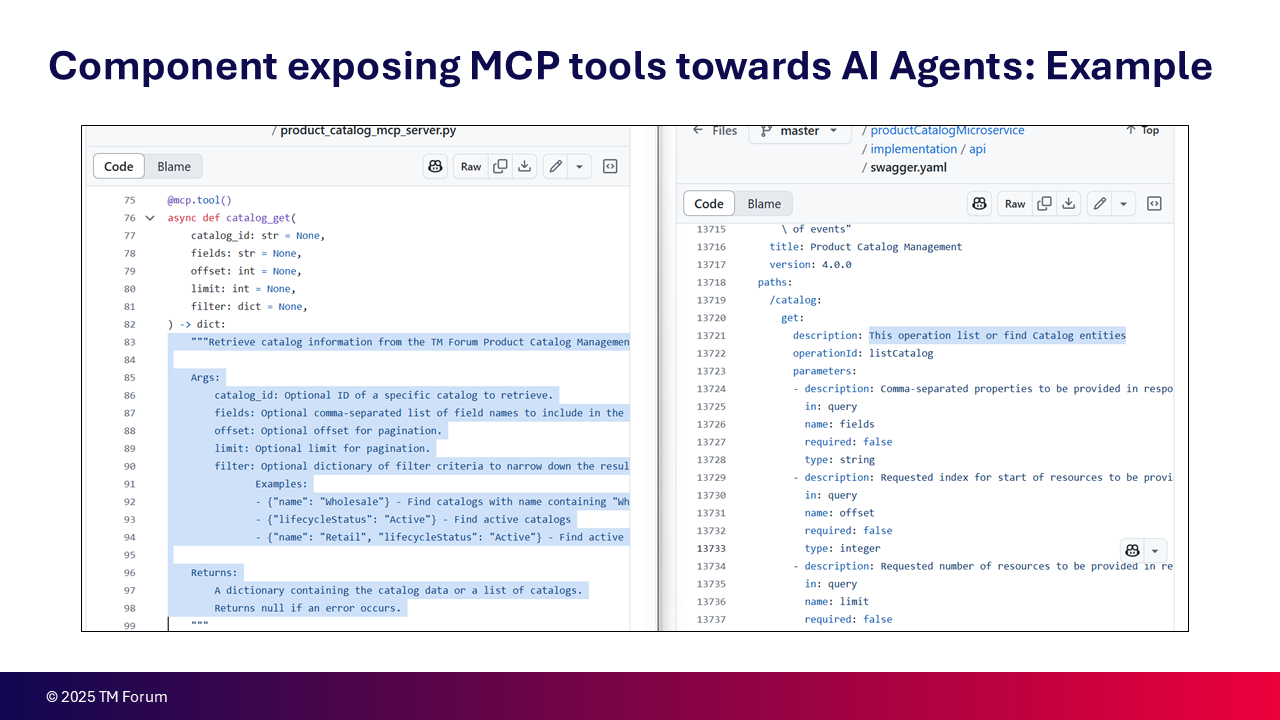
MCP is fundamentally about describing APIs in natural language so agents understand how to use them. The most important part of MCP implementation is the English description of both the API function and all arguments. This contrasts sharply with Swagger descriptions, which were designed for API experts, not AI agents.
Key implementation findings:
Arguments require detailed explanation and examples
Language models work better with specific examples in the descriptions
Filtering and complex parameters need explicit examples for agents to use them effectively
The API workstream has recognized that MCP wrappers could be generated automatically from Swagger files by upgrading descriptions with more detail and examples, assuming these Swaggers might be consumed by language models.
Agents Packaged as Composable ODA Components
Assumptions for Agentic Components
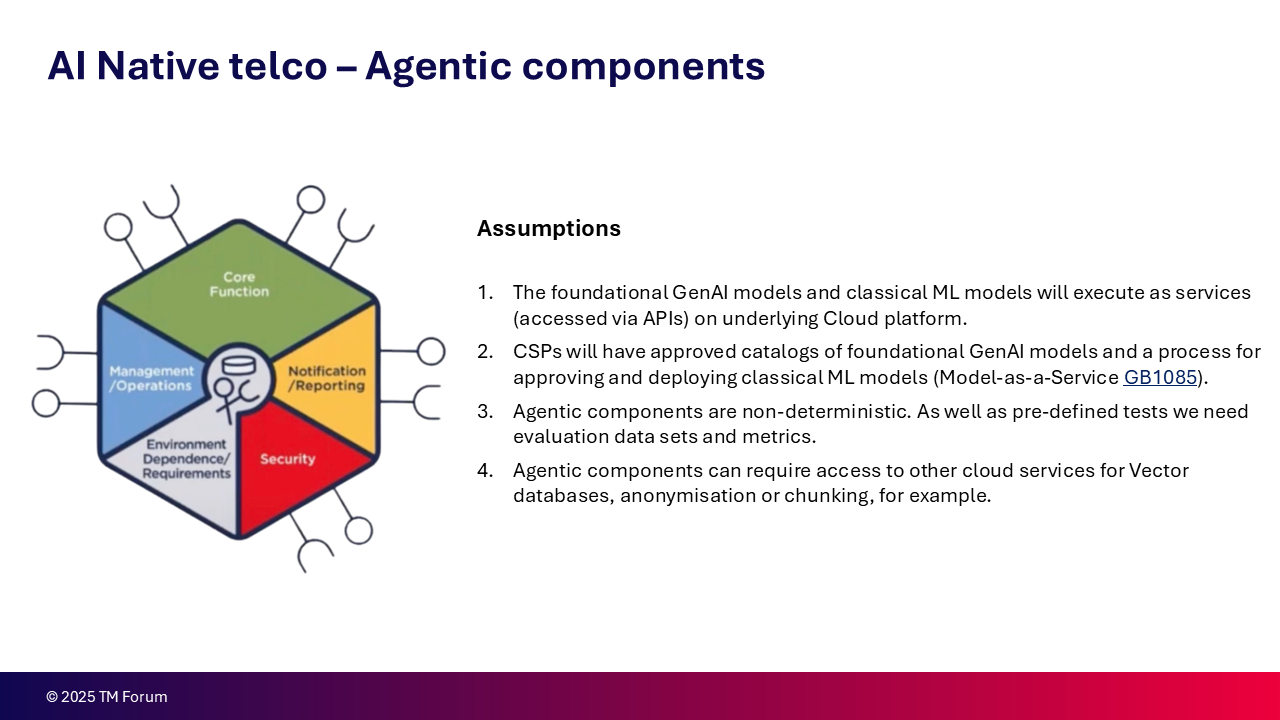
The extension of the component model to support agents is based on several key assumptions:
Foundational models as services: GenAI models and classical machine learning models execute as services accessed through APIs on the underlying cloud platform. Agent software accesses language models through APIs, consistent with most agent frameworks today.
Approved model catalogs: CSPs will maintain approved catalogs of foundational GenAI models. This is standard practice - for example, at Vodafone, the common platform requires any language model to be on an approved list, with a rigorous process for adding new models while maintaining privacy and security standards.
Non-deterministic systems: Agentic components are non-deterministic, requiring significantly more testing. The preferred term is “evaluation” - components need comprehensive evaluation datasets and metrics to continuously evaluate agent performance against expectations.
Additional canvas services: Agent components typically require additional cloud services like vector databases, anonymization services, and chunking services, which need to be available in the Canvas.
Extending the Component Model
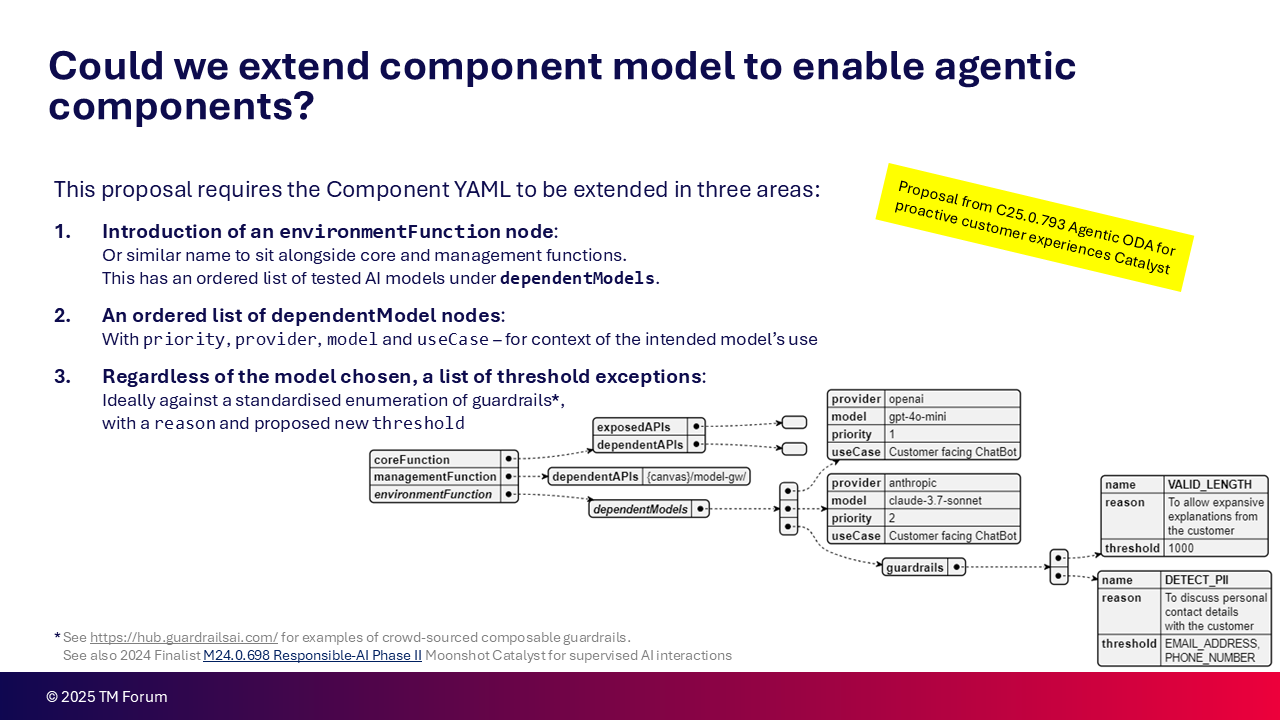
The component model extension originated from the “Agentic ODA for Proactive Customer Experiences” Catalyst. The approach allows components to declare which language models they want to access, providing a prioritized list. The Canvas platform then grants access to whichever subset are available in the approved language models.
Similar to exposedAPIs and dependentAPIs, the specification includes dependentModels, where components:
Describe the models and their priority
Provide details about the use case (required for use case inventory)
Define guardrails to ensure responsible AI usage
The declarative requirements allow components to define their thresholds against guardrails as well.
AIVA as Example Agentic Component
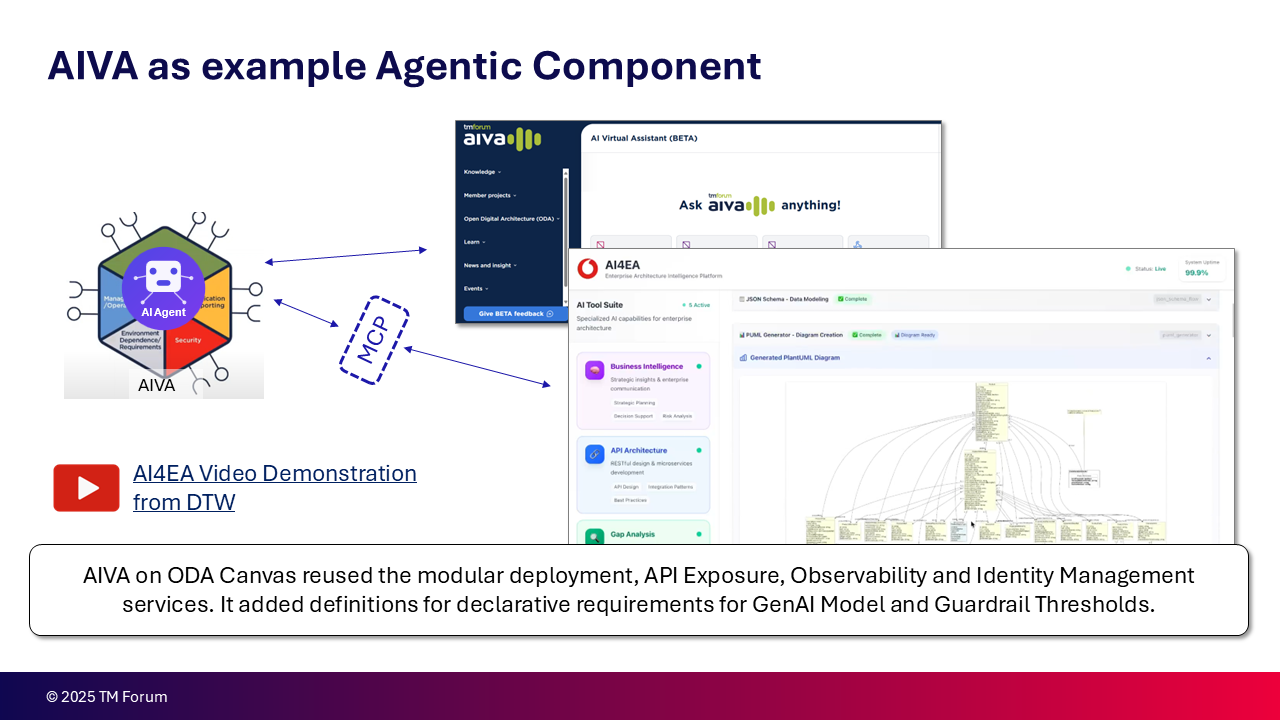
The implementation was showcased at DTW using AIVA (TM Forum AI Assistant) packaged as a component and deployed on the Canvas. As an API-first component, AIVA was tested through direct API integration (not through the AIVA portal), allowing other agents to communicate directly with AIVA through APIs.
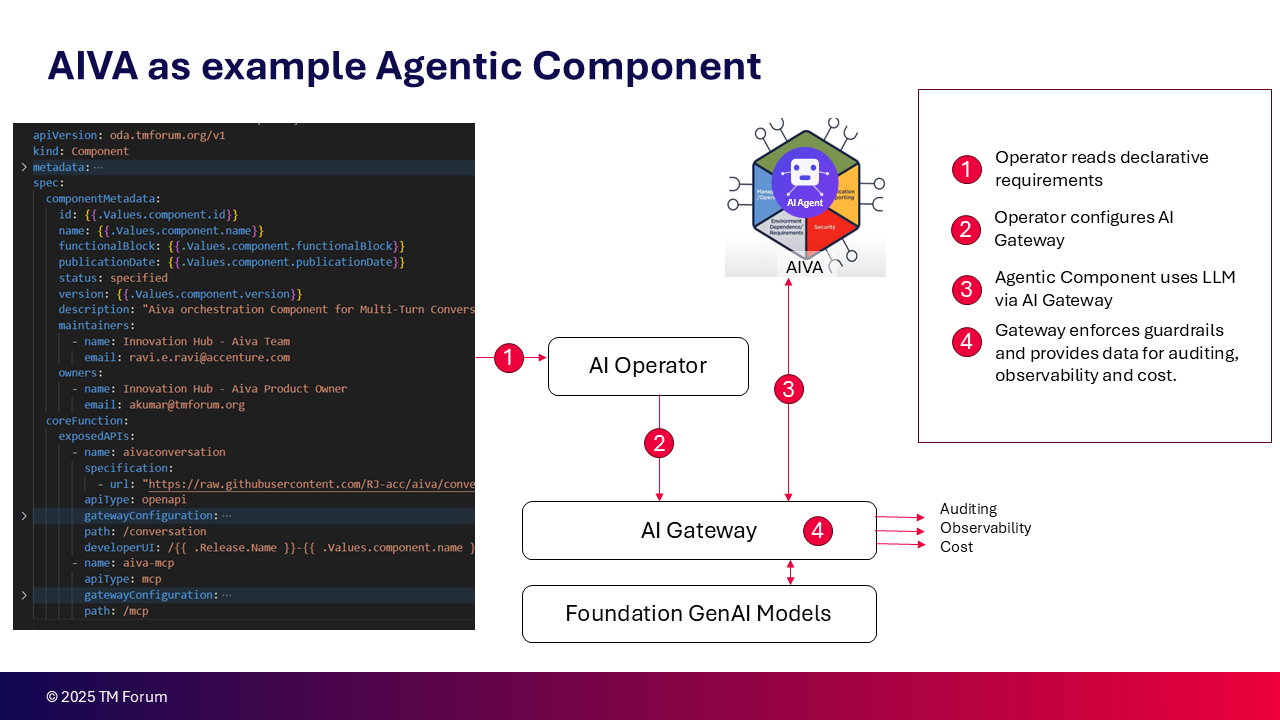
Deploying AIVA on the Canvas provided immediate use of all existing Canvas services:
Modular deployment
API exposure through API Gateway
Observability
Identity management
These capabilities come standard when deploying agents as software components and are essential for any agent deployment.
AI Gateway
To grant access to foundational GenAI models, the Canvas introduces an AI Gateway. When granting access to unknown models, access is provided through this gateway (or proxy), which enables:
Auditing: All interactions are audited, essential for responsible AI practices
Observability: Exact monitoring of what’s being discussed between components, agents, and underlying language models
Cost management: Understanding how many tokens of which model a component is consuming
The process follows four steps:
An operator reads the declarative requirements
Configures the AI Gateway
Grants the component access with authentication and input details for accessing language models
Enforces guardrails while providing data for auditing, observability, and cost management
This forms the foundation for what the Canvas must provide to support multi-vendor AI agents across every functional domain, enabling governance, control, and responsible AI adoption at scale.
Canvas Services to Support AI Agents at Scale
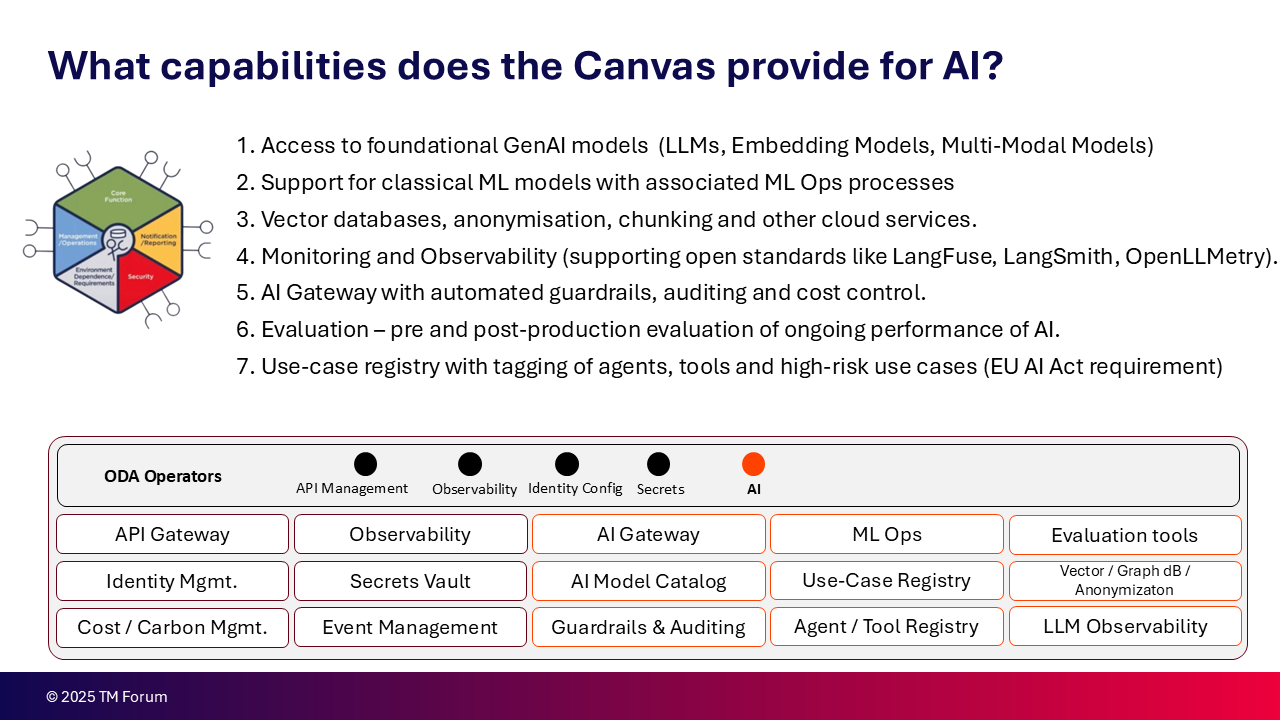
For multi-vendor AI agents across every functional domain, the Canvas needs:
AI Models and Services
Language models: Foundation GenAI models
Other AI models: Embedding models, multimodal models
Classical ML models: With correspondent MLOps processes
Additional capabilities: Vector databases, anonymization, chunking, and other cloud services
Observability
Observability extends beyond technical monitoring and performance of standard software to include AI-specific observability for language models, supporting tools like:
LangSmith
OpenLLMetry (an OpenTelemetry extension)
AI Gateway
A standard architectural component enabling:
Automated guardrails
Auditing of all AI interactions
Cost management and token tracking
Evaluation Framework
Support for both:
Pre-production evaluation
Post-production continuous evaluation of ongoing AI performance
Use Case Registry
A Canvas registry with tagging of:
All agents
Tools
High-risk use cases (requirement for EU AI Act)
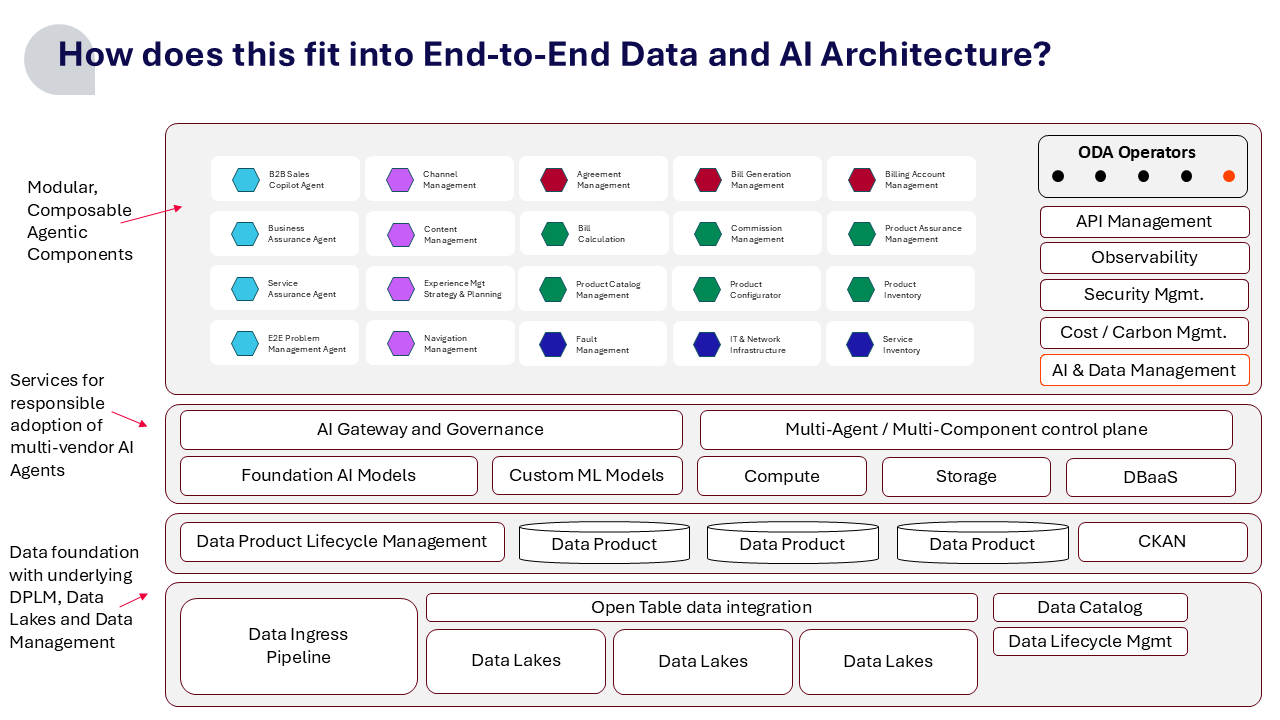
End-to-End Data and AI Architecture
The AI-Native Canvas fits within the end-to-end AI and data architecture through collaboration between the Composable IT mission (where Canvas and Component work resides) and the AI and Data mission.
Canvas Pre-AI
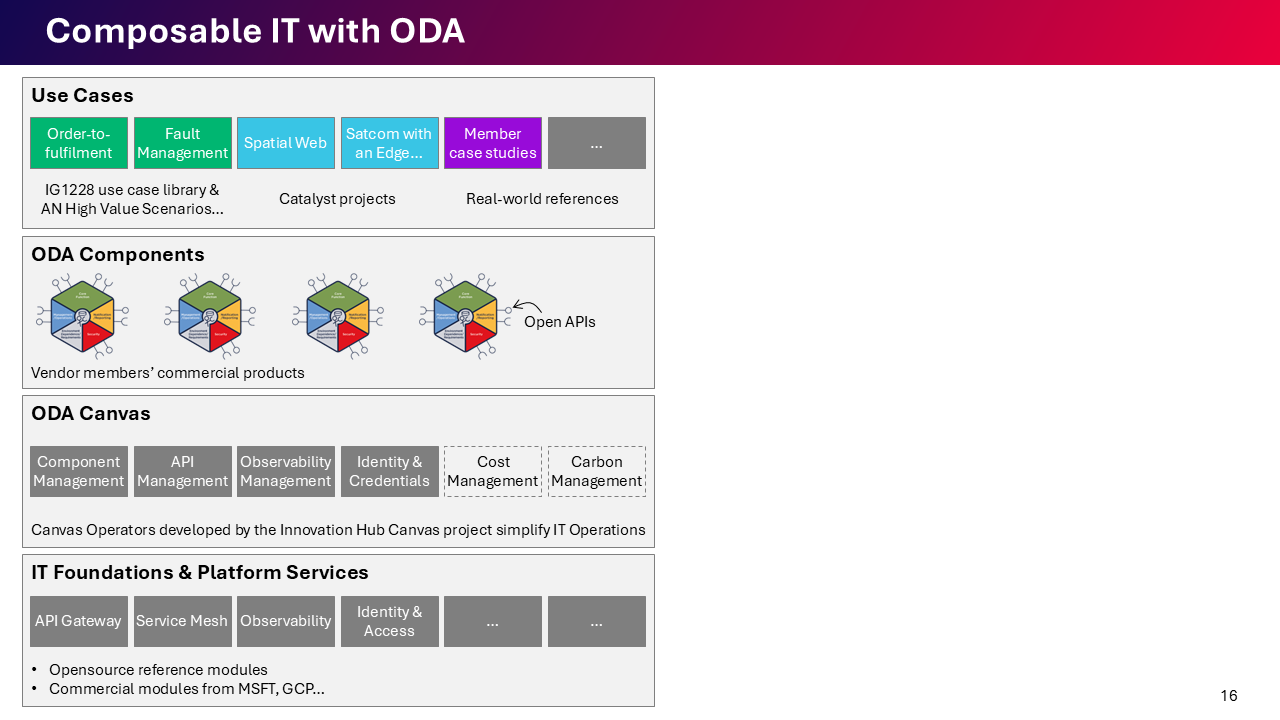
Historically, composable IT within ODA consisted of:
Modular standard components: Extensive work building components with use cases and Catalyst programs
ODA Canvas: Operators read component requirements and configure underlying cloud platform services
Foundational services: API Gateways, service meshes, observability, identity and access management systems
Canvas with AI and Data Extensions
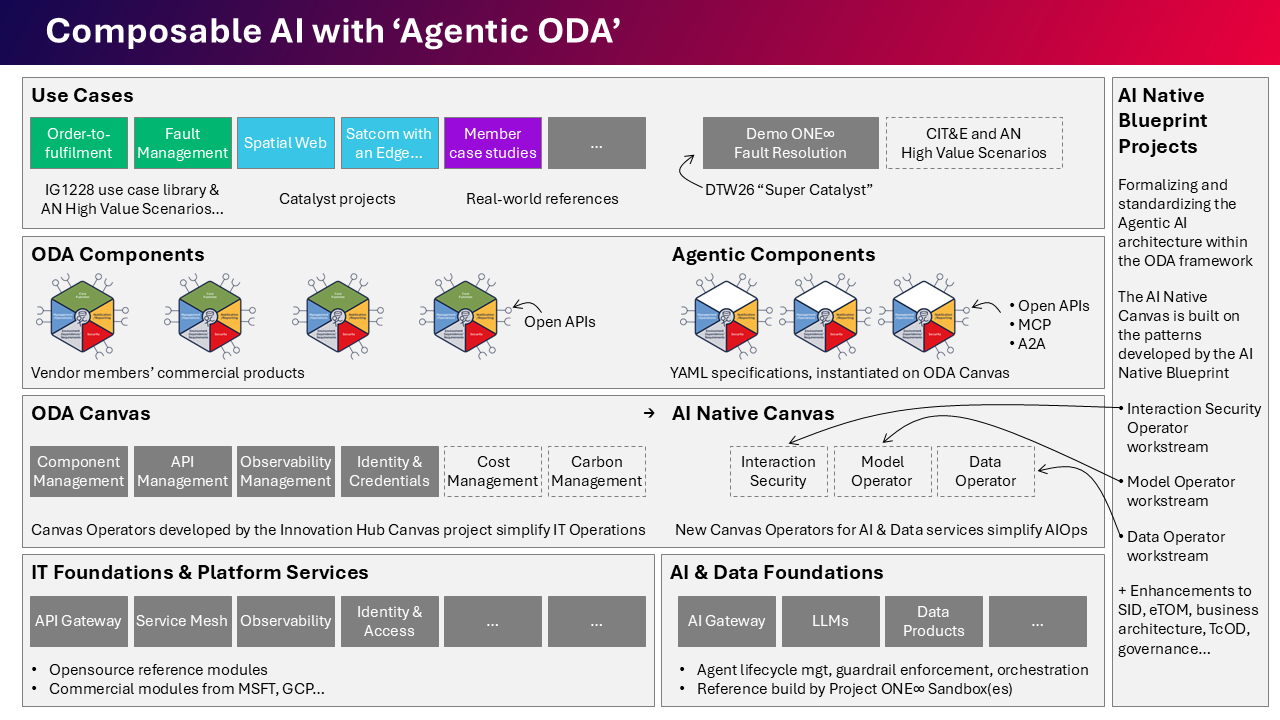
The AI-Native Canvas extensions add:
Agentic components: Alongside standard ODA Components
MCP interfaces: Components can offer MCP so they’re available as tools toward other agents
Agent-to-Agent (A2A) standards: Support for emerging standards like Google’s A2A protocol, where agent components expose “agent cards” explaining their capabilities as part of a YAML contract in the component specification
AI operators: Model operators that read declarative requirements and configure the AI Gateway
Data products as a service: Future extension where components declare requirements for data products, with data operators integrating and granting access through underlying data services
The patterns already established fit naturally with these AI services. The experimentation has successfully extended the ODA Component model for agentic components.
Note on standardization: Agentic components are shown in white (vs. colored systems of record components) to indicate that, similar to engagement management, we want to enable deployment of agents as components following the component model, without requiring standardized agents. This allows non-standard agents to seamlessly interact and interrogate all systems of record components, leveraging the foundational data within TM Forum standards.
Canvas Resource Inventory
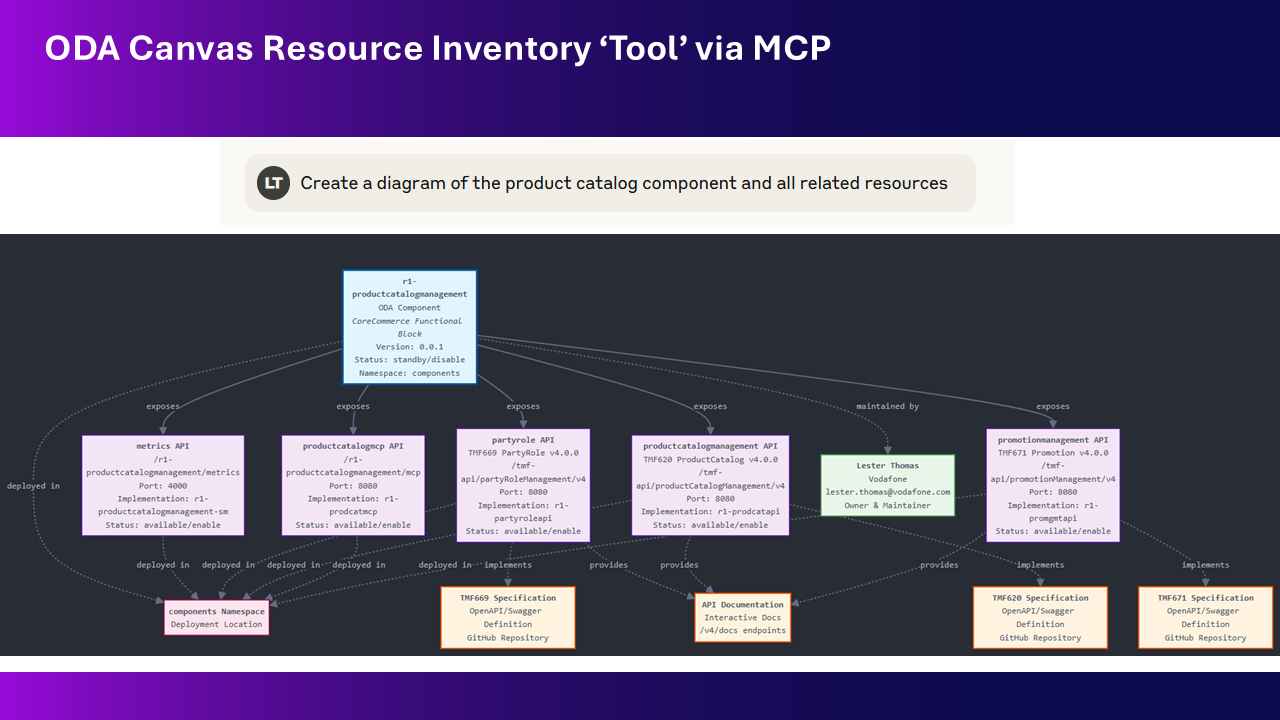
On top of the Canvas, a resource inventory has been built that serves as a registry of components, agents, tools, and use cases. The Canvas uses the TMF639 Resource Inventory API as a standard interface, making it straightforward to expose components and APIs into a TM Forum-compliant resource inventory.
As with all TM Forum APIs, the resource inventory can be exposed as an MCP server to make it available to AI agents. This means:
External AI agents (e.g., Claude Desktop) can integrate with the Canvas using the MCP server as a tool
Agents can query in natural language: “What resources are available in the ODA Canvas?”
Agents can request detailed descriptions of specific components and APIs
Agents can even create diagrams of component architectures automatically
This enables AI agents to discover and understand the Canvas architecture, making the platform self-documenting and accessible through natural language interfaces.
Classical ML Models
In addition to GenAI models, the Canvas supports classical machine learning models through an AI Model Manager.
For custom machine learning models, the component needs to include that custom model as part of the component definition. Similar to how container images are specified in Kubernetes manifests, components include a URL to a machine learning model in an accessible model repository.
The Model Manager operator:
Downloads the model
Submits it into an MLOps pipeline for review, testing, and deployment
Once approved and deployed, provides API access to the inference engine so the component can access the custom model
This approach enables components to package and deploy their own custom ML models while maintaining proper governance and operations processes.
Evaluation and Testing
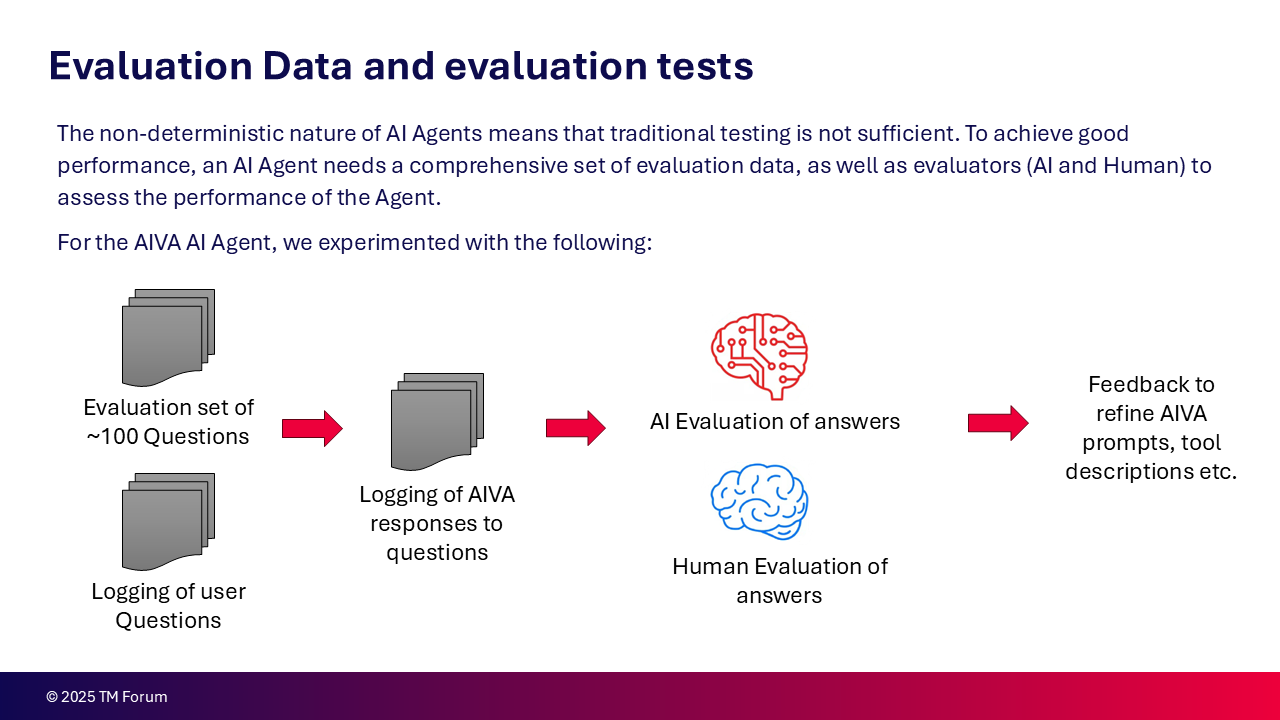
Because AI services are non-deterministic, components should come packaged with complete evaluation datasets and tests.
Evaluation Approach
Pre-deployment: Conduct comprehensive evaluation to establish baseline performance for the agent
In production: Continuously evaluate and monitor agent behavior and characteristics
AIVA Evaluation Implementation
For the AIVA agent component:
Golden dataset: Created 87 evaluation questions representing the types of questions someone might ask the TM Forum AI Assistant
Usage logging: During real usage, log user questions and AIVA responses, gathering information about what people are actually asking
Evaluation questions and responses: Create evaluation datasets with AIVA responses for automatic and human-based manual evaluation
Evaluation Methods
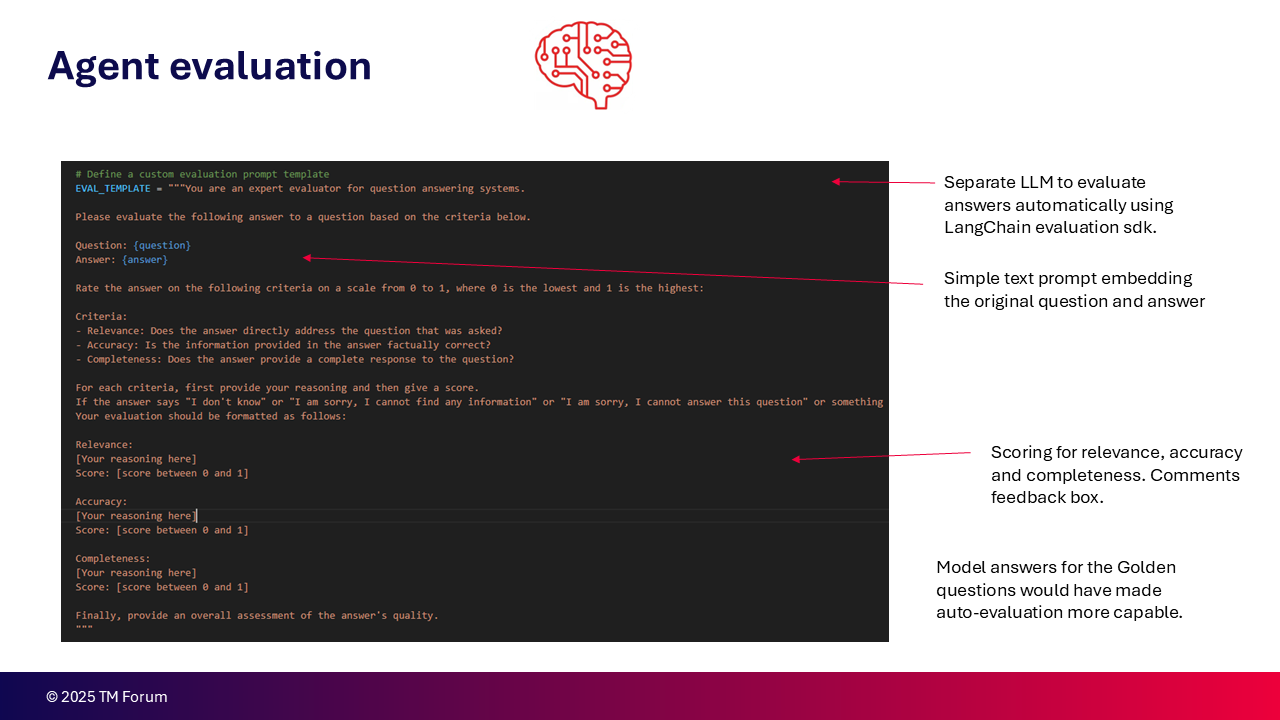
AI-based evaluation: At scale in production, use AI-based evaluators to evaluate AIVA’s performance and responses using frameworks like the LangGraph open-source evaluation framework. The AI evaluator uses prompt templates:
“You are an expert evaluator”
Provides the question and answer
Asks the AI model to evaluate for relevance, accuracy, completeness
Provides overall assessment
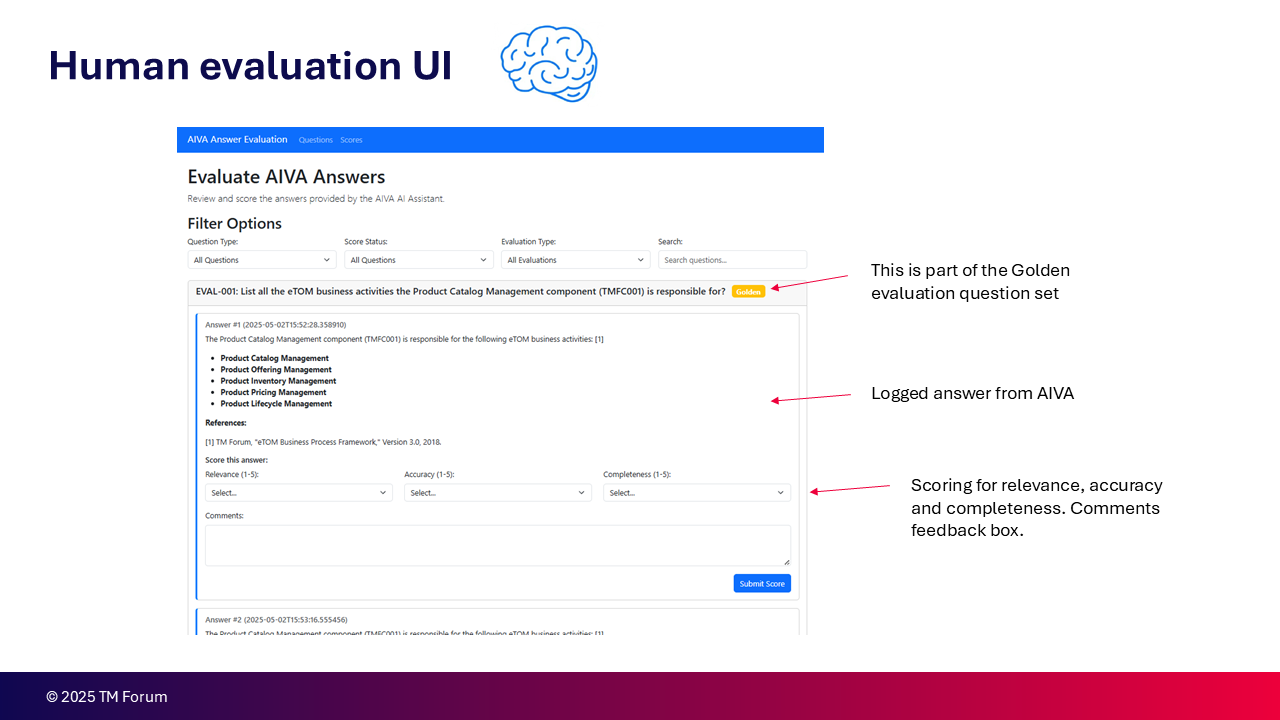
Human evaluation: Built an interface for human evaluators to score responses for:
Relevance
Accuracy
Completeness
Commentary on scoring rationale
Evaluation Dashboard
The evaluation framework provides:
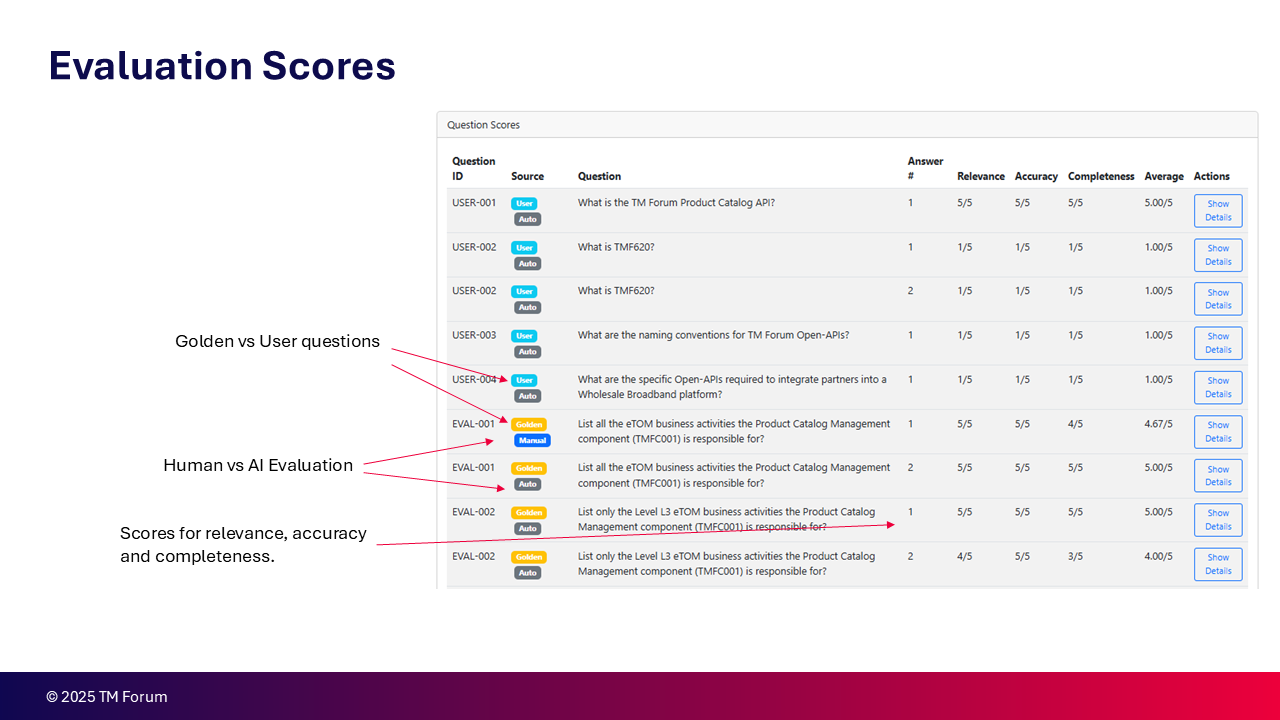
Metrics distinguishing golden questions vs. user questions
Tracking of manual vs. automatic AI evaluation
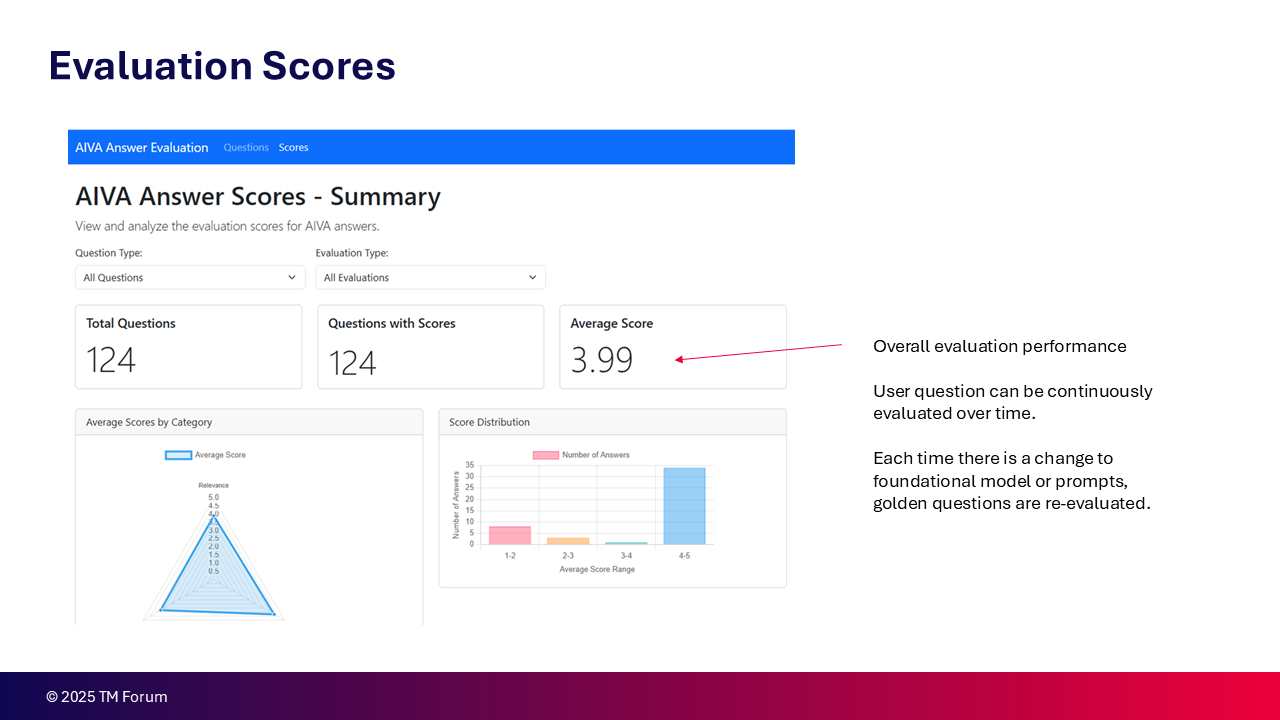
Dashboard to monitor agent performance over time
Ensuring changes improve overall performance before deployment
This continuous evaluation is essential for maintaining quality in non-deterministic AI systems and provides the confidence needed for production enterprise deployments.
Summary
The AI-Native Canvas demonstrates that the Open Digital Architecture isn’t just ready for AI - it’s architected to make AI operationally viable at telecommunications scale.
Key Achievements
MCP integration: Components can expose MCP interfaces, making them available as tools for AI agents
Agentic components: Agents can be deployed as modular, composable components following the ODA Component model
Multi-agent architectures: Support for multi-vendor, multi-agent systems with proper governance and control
AI Gateway: Provides auditing, observability, and cost management for AI interactions
Evaluation framework: Continuous evaluation for non-deterministic AI systems
Resource inventory: Self-documenting Canvas accessible through natural language
Operational Benefits
The Canvas provides the foundation for CSPs to confidently deploy and operate multi-vendor agent architectures across every functional domain with:
Governance and control: Required for enterprise scale operations
Responsible AI practices: Auditing, observability, cost control, continuous evaluation
Regulatory compliance: Use case registry and high-risk tagging for EU AI Act
Production-ready: All the operational capabilities needed for enterprise telecommunications systems
Reference Video
Full presentation: The AI-Native ODA Canvas (13:52)